
Theoretical Principles and Development Trends of Nylon Modification
Nylon (Polyamide, PA), as one of the five major general engineering plastics, holds a significant position in the automotive, electronics, and industrial manufacturing sectors due to its excellent mechanical strength, wear resistance, and self-lubrication. However, pure nylon resin suffers from high water absorption, low impact strength in dry and low-temperature conditions, and flammability, which limits its application in extreme environments. Nylon modification technology uses physical or chemical means to introduce a second component while retaining the advantages of the nylon matrix, forming a complementary microstructure to "maximize strengths and offset weaknesses." This article explores the underlying logic of nylon modification and analyzes current technological frontiers.
Core Principles of Nylon Modification
The essence of nylon modification is composite modification based on polymer physics and chemistry, aiming to achieve macroscopic performance improvement through the regulation of microstructure.
1. Toughening Modification: Solving Low-Temperature Brittleness Nylon molecular chains tend to freeze at low temperatures, making the material brittle. Toughening modification involves introducing elastomers (such as core-shell acrylic ester elastomers) or rubber particles, which are uniformly dispersed in the nylon matrix as fine particles. When the material is impacted, these dispersed phases act as stress concentrators, inducing the matrix to generate a large number of crazes and shear bands, thereby absorbing a significant amount of impact energy. For instance, super-tough nylon can significantly improve low-temperature impact strength at -40°C, effectively solving the cracking problem of traditional nylon in cold environments.
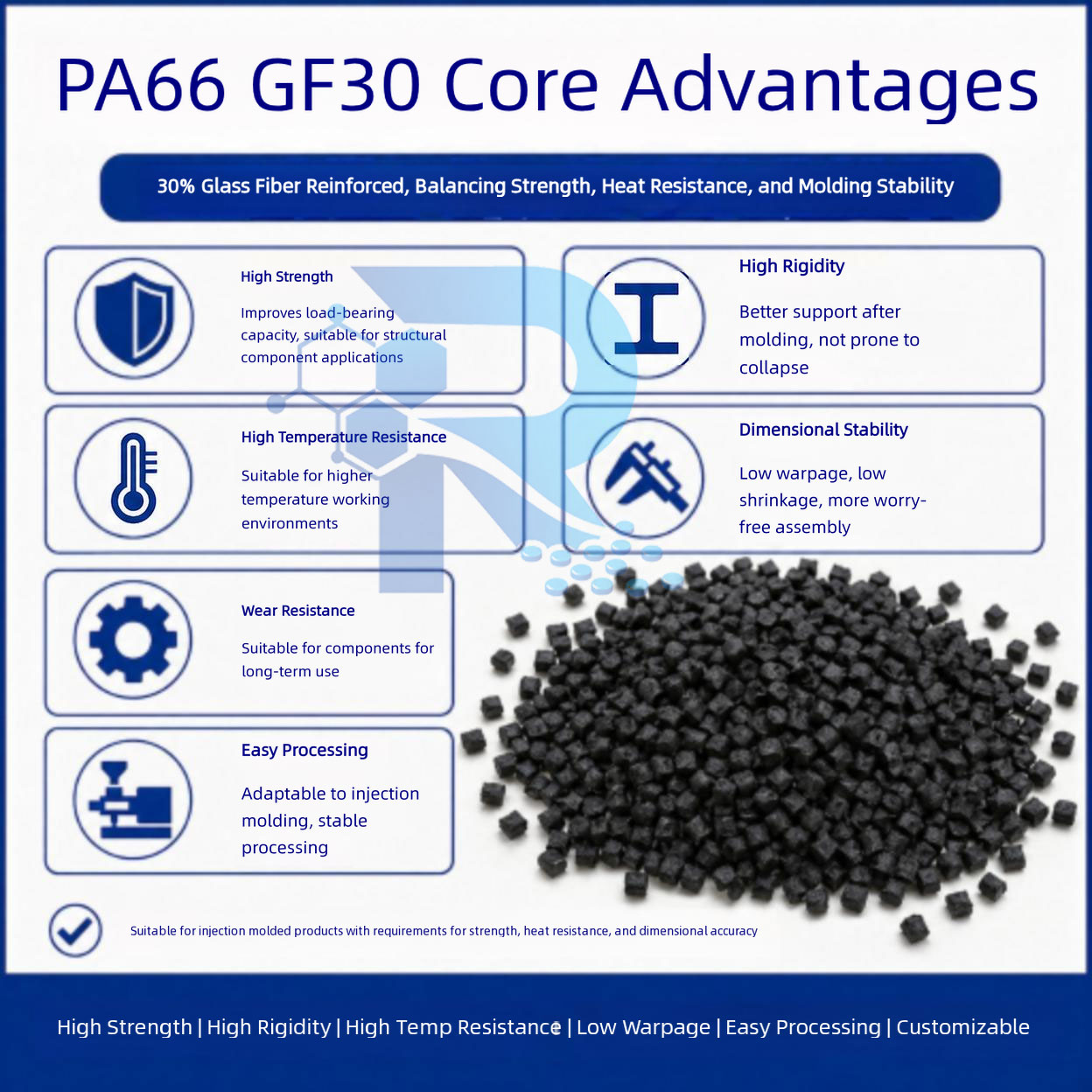
2. Reinforcement Modification: Enhancing Rigidity and Heat Resistance Reinforcement modification is the most widely used technology in industrial applications, mainly achieved by introducing glass fibers (GF) or carbon fibers (CF). Fibers act as skeletal materials, bearing most of the external load. Among them, Long Fiber Reinforced Thermoplastic Nylon (LFT-PA) has become a high-end direction due to its excellent creep resistance and impact resistance. Additionally, nanocomposite technology is a recent hotspot, utilizing the huge specific surface area and high surface activity of nanomaterials to enhance the bonding force between nylon macromolecules, thereby significantly improving the material's strength and heat resistance with low filling content.
3. Flame Retardancy and Alloying Technology With the rise in safety standards, halogen-free flame retardancy has become the mainstream. The phosphorus-nitrogen intumescent flame retardant system works synergistically to form a char layer on the material's surface, isolating oxygen and heat, while producing low smoke and no toxicity during combustion. Meanwhile, nylon alloying (such as PA/ABS, PA/PPS) uses blending technology to combine the characteristics of different polymers, such as utilizing the excellent processability of ABS and the chemical resistance of PA to create new materials with superior comprehensive performance.
Technical Challenges and Customized Solutions
Although modification technology is relatively mature, in practical applications, customers often face the challenge of balancing multiple performance metrics. For example, while high glass fiber filling improves strength, it can lead to warpage and surface floating fibers; the addition of flame retardants often sacrifices mechanical properties. Furthermore, different application scenarios have distinct requirements for the material's fluidity, weather resistance, and electrical properties.
Faced with these complex engineering problems, standardized general grades often struggle to fit perfectly. At this point, professional customized modification services become crucial. Shenzhen Renjie Plastic Raw Material Co., Ltd. possesses deep technical accumulation in this field and can provide precise nylon plastic modification customization services according to the specific application needs of customers. Whether it is high-end toughened nylon needed to replace imports, or weather-resistant and flame-retardant materials for special environments, Renjie Plastic can adjust the formula system and processing technology to create the most cost-effective solution for customers.
Future Development Trends
Looking ahead, nylon modification technology will show the following trends: First, Green and Environmental Protection, where bio-based nylon and recyclable modification technologies will receive more attention; Second, Functional Diversification, where multi-functional integrated materials such as conductive, antibacterial, and thermally conductive properties will become R&D priorities; Third, Processing Convenience, such as the development of non-drying nylon materials, which will significantly reduce energy consumption and time costs for downstream injection molding enterprises.
In summary, nylon modification is a systematic engineering involving formula design, process control, and application testing. Through scientific modification means, the potential of nylon materials is infinitely excavated, continuously driving the upgrade and development of downstream manufacturing industries.