
AntiStatic Compound
HIPS ESD Compound
Model: 302AN/600AN/620AN
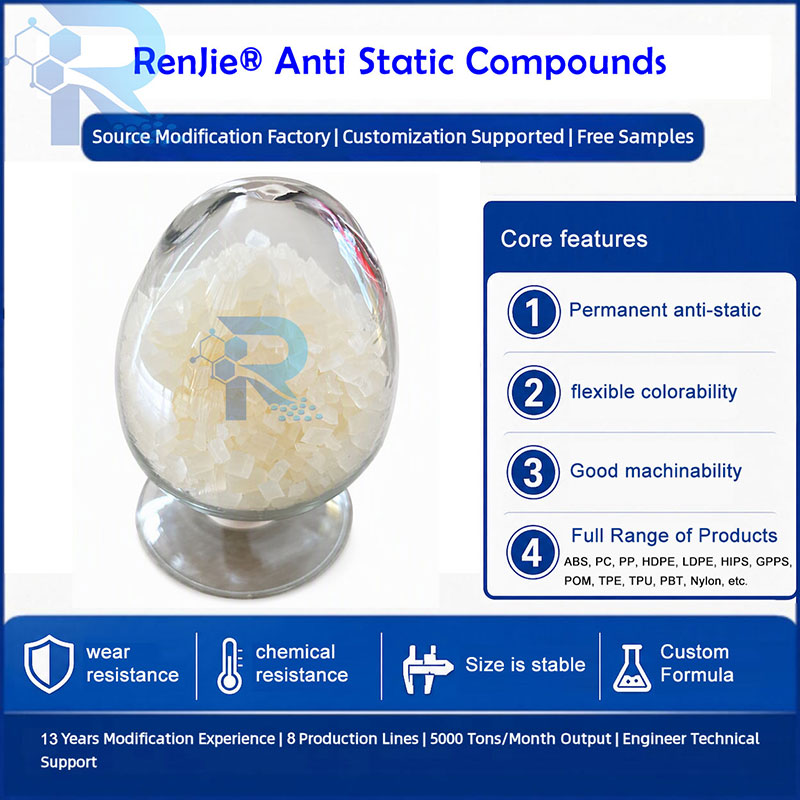
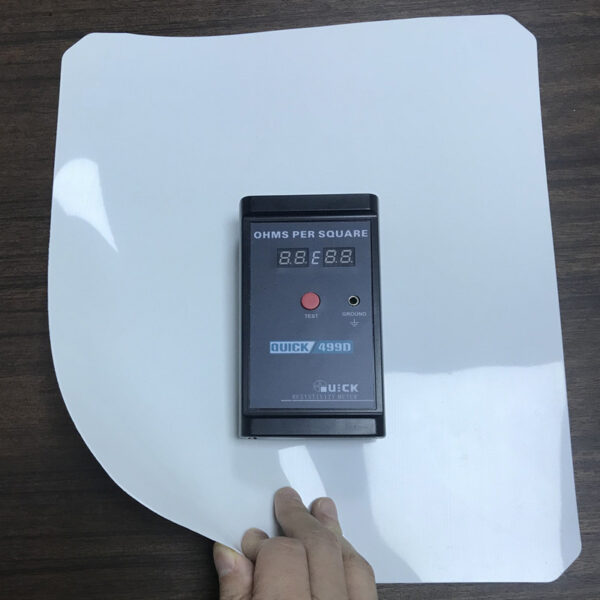
Polystyrene ESD composite, surface resistance 10 ^ 7–10 ^ 8 Ω/sq, permanent antistatic, no migration, no precipitation, suitable for extrusion injection molding. Contains PS antistatic masterbatch and sheet processing technology.
| Product Description | PS ESD Compound |
|---|---|
| RenJie®Grade | 302AN/600AN/620AN |
| Base Polymer | Polystyrene (HIPS) |
| Material Characteristic | Antistatic Polystyrene |
| Surface Resistance | 6.2×10E7 Ohms |
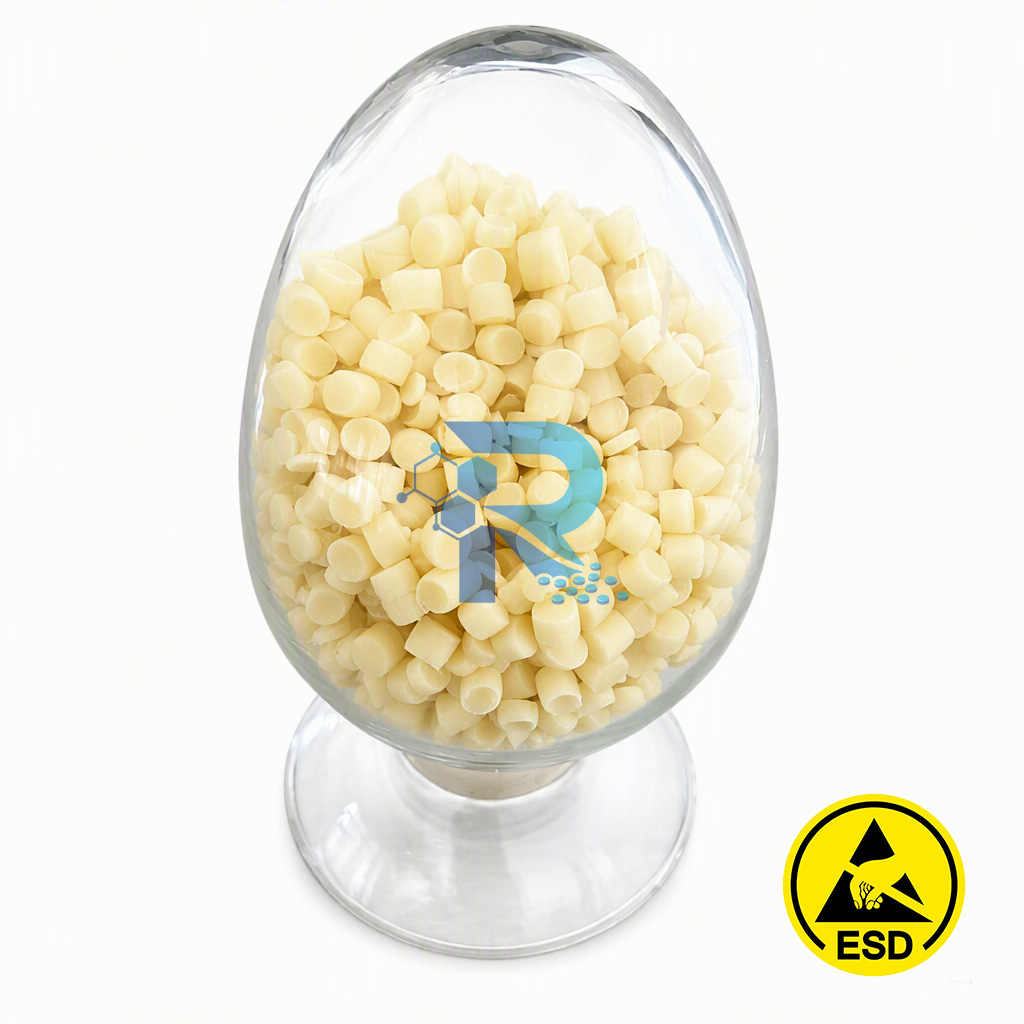
| Appearance | Granules/lightly pale yellow |
What Is Polystyrene ESD Compound?
RENJIE® PS 302AN is a modified antistatic compound for HIPS thermoforming film or sheet. It delivers permanent antistatic performance with a surface resistivity of 10^7 Ω/sq. PS 302AN can also be used as an antistatic masterbatch at 50%–75% dosage, depending on the target resistivity. It shows no migratory effect and no bleeding out on the surface of finished parts, giving stable long-term antistatic performance.
Polystyrene ESD compound (PS ESD compound) is an antistatic modified material based on polystyrene (PS) with permanent antistatic properties. Its surface resistance is 10^7–10^8 Ω/sq, making it suitable for extrusion and injection molding. Polystyrene antistatic masterbatch is the concentrated version of PS ESD compound: it reaches a lower surface resistance of 10^7 Ω/sq and is recommended for manufacturers of PS sheets and films.
Applications of Polystyrene ESD Compound
PS ESD compound serves fields with strict static-control requirements, including electronics, electrical, communications, semiconductors, medical equipment and chemicals. In these industries, antistatic polystyrene material helps to:
- prevent static discharge from damaging sensitive electronic components and circuits;
- prevent static attraction of dust and impurities that degrades product quality and performance;
- reduce safety risks such as fire and explosion caused by static sparks.
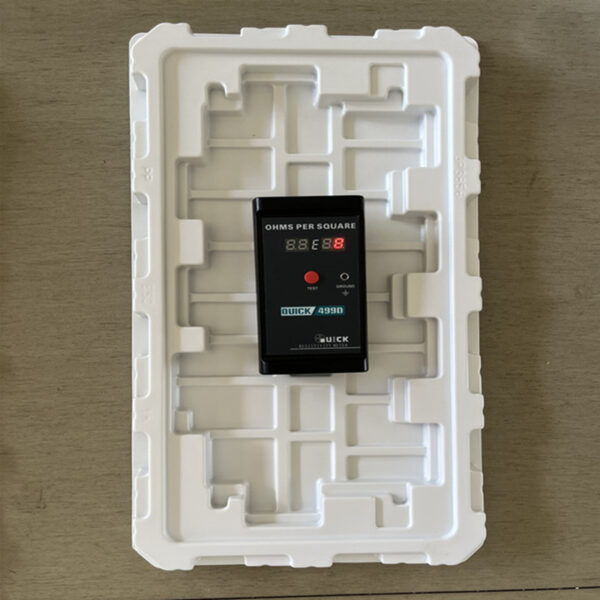
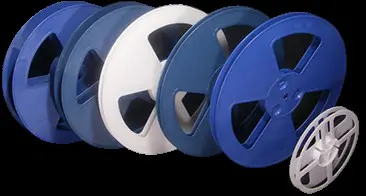
Typical parts include packaging materials, antistatic trays, conveyor trays, carrier reels, electrical housings, electronic parts, and accessories for electronic components.
Key Characteristics of Polystyrene ESD Compound
1. Permanent antistatic performance ESD PS compounds typically contain 10%–25% antistatic additives, which effectively reduce or prevent the generation and accumulation of static charge, giving PS parts a lasting antistatic effect that does not depend on ambient humidity.
2. Excellent processing performance The material runs on common processes such as injection molding, extrusion and blow molding. Processing is easy to control and supports complex geometries and a wide range of part shapes.
3. Good chemical stability It tolerates most chemical substances and resists attack by acids, alkalis and organic solvents. Aging resistance is good, so performance and service life hold up in long-term use and in demanding chemical environments.
4. Relatively low cost Compared with most antistatic materials, PS ESD compound is cost-efficient while still delivering very low surface resistivity and high gloss for appearance-critical applications. It meets antistatic requirements while lowering material cost and improving product competitiveness.
5. Recyclable Polystyrene is a recyclable material that meets environmental requirements, helping to cut pollution and resource waste. It can be reprocessed into plastic products multiple times and is suitable for hygiene-critical packaging in food and medical applications.
Extrusion Processing of Polystyrene ESD Sheet
PS ESD compound is widely used to produce antistatic polystyrene sheet. Depending on the surface resistance required, RENJIE® offers two routes:
| Route | Grade | How it is used | Best for |
|---|---|---|---|
| Dedicated ESD compound | RENJIE® 620AN | Customized to the target surface resistance; compounded directly | Sheet producers running fixed formulations |
| Antistatic masterbatch | RENJIE® 600AN | Dry-blended by the processor in proportion to the target resistance, then extruded | Sheet and film producers needing flexible resistivity |
Polystyrene antistatic masterbatch is more cost-effective than PS ESD compound.
Extrusion procedure:
- Weighing — prepare RENJIE® 620AN at 85%–90% by weight, composite toughening additives at 5%–10%, and other additives at 1%–2%.
- Mixing — charge the ingredients into a high-speed mixer and blend until uniform.
- Drying — dry the mixture with hot air at 85–95°C for 4–5 hours.
- Extrusion — feed the dried mixture into a sheet extrusion line for melting, blending and extrusion molding. Control the temperature carefully: PS ESD compound generally processes about 10°C lower than regular PS resin, which protects the antistatic system from thermal degradation.
- Finishing — calender, trim and wind the sheet according to the end use.
Note: the processing technology of antistatic polystyrene sheet varies with the specific application and requirements. The source text is truncated at "It is recom…"; the remaining recommendations should be added here.
3. FAQ (ready for FAQPage schema)
Q1: What is the surface resistance of polystyrene ESD compound?
A: PS ESD compound is rated 10^7–10^8 Ω/sq; RENJIE® PS 302AN and the antistatic masterbatch reach 10^7 Ω/sq.
Q2: What dosage is used for PS antistatic masterbatch?
A: As a masterbatch, RENJIE® PS 302AN is added at 50%–75%, depending on the target surface resistance. Antistatic additive loading inside the base ESD PS compound is typically 10%–25%.
Q3: Does the antistatic effect fade or bleed out over time?
A: No. The system is permanently antistatic, with no migration and no surface bleeding, so performance stays stable.
Q4: Can PS ESD compound be injection molded?
A: Yes — it supports injection molding, extrusion and blow molding.
Q5: How should processing temperatures be set?
A: Process roughly 10°C below regular PS resin, and dry at 85–95°C for 4–5 hours.
Q6: Is it suitable for food and medical packaging?
A: Polystyrene is recyclable and suitable for hygiene-critical packaging in food and medical applications; confirm compliance against local regulations.
| Product Description | PS ESD Compound |
|---|---|
| RenJie®Grade | 302AN/600AN/620AN |
| Base Polymer | Polystyrene (HIPS) |
| Material Characteristic | Antistatic Polystyrene |
| Surface Resistance | 6.2×10E7 Ohms |
| Appearance | Granules/lightly pale yellow |
| Features | High impact streng |
| Applications | ESD PS sheet, ESD PS thermoforming film,carrier reel |
| Processing | Extrusion/Injection |
Related products
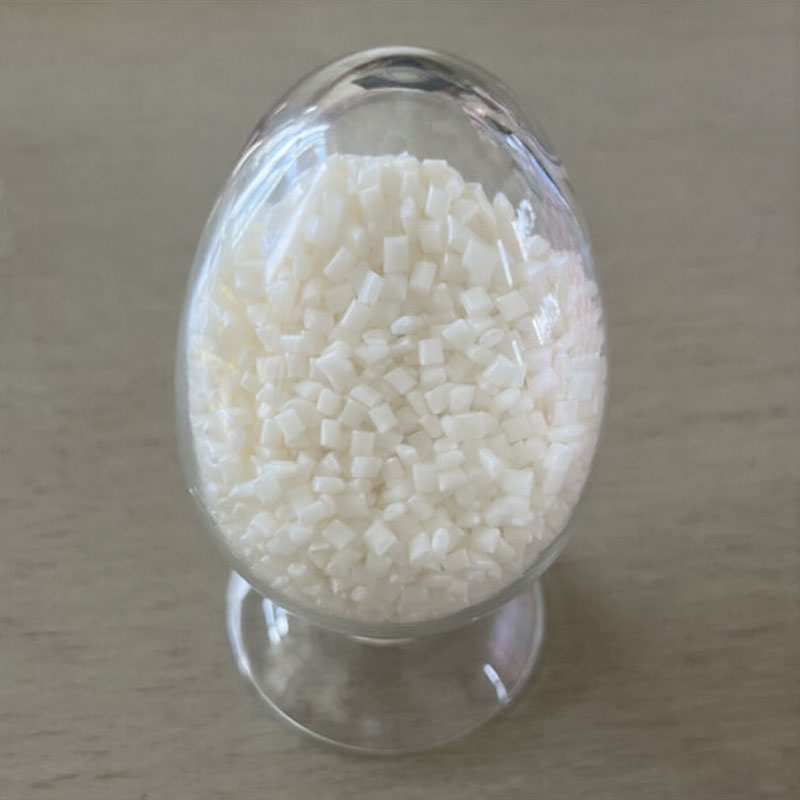
709AN/747AN/920AN
Antistatic ABS Compound
RENJIE® antistatic ABS compound with 10^8–10^10 Ω surface resistance. 709A…
View details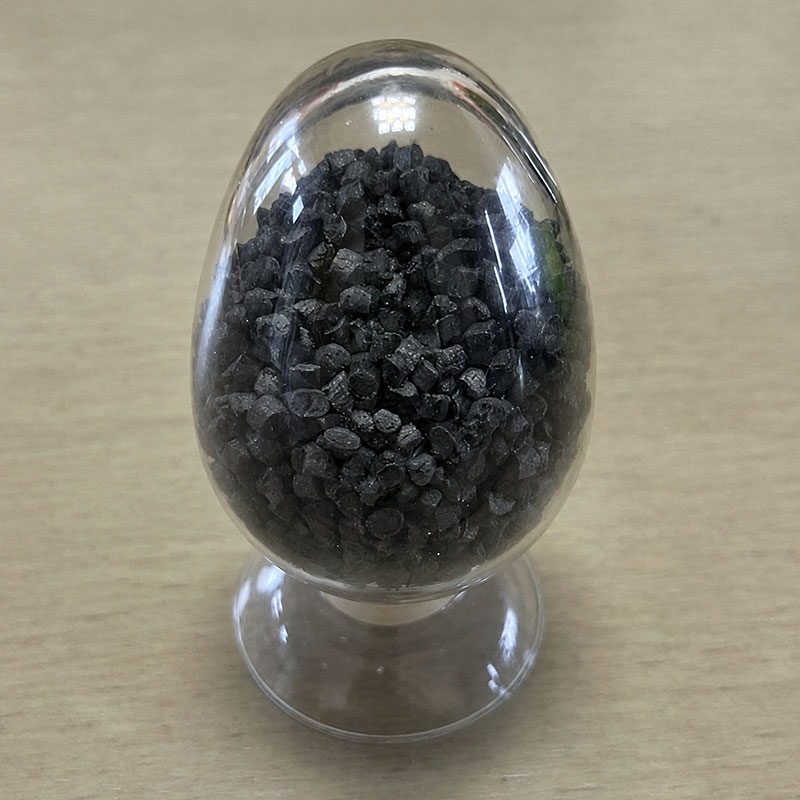
757CF20/757CF30/757CF15
15% Carbon fiber ABS
RENJIE carbon fiber reinforced ABS is a high-performance thermoplastic com…
View details70CF30/70CF20/70CF15
30% Carbon Fiber Nylon 66
Explore Carbon Fiber Conductive Nylon properties, CFRTP Conductive Nylon g…
View detailsRequest a quotation or sample
We reply with price, MOQ and lead time within one business day.
Need a quotation or product data?
Send us your specification and we will come back with a solution within 24 hours.